A New World
The model is the host. mvec is the computer. Traditional computing is the coprocessor.
We started by asking what software should look like when an agent is a first-class user. Following that question downward through the stack leads somewhere stranger: a computer where a neural model owns the top of the machine, while deterministic state, authority, execution and hardware remain explicit.
AI has mostly been inserted into an old computer.
For most of computing history, the shape of the machine has been stable. Programs run on an operating system. The operating system manages hardware. Humans operate programs through interfaces.
Even computer-use agents preserve the old shape. The model looks at someone else’s interface, moves someone else’s cursor, opens someone else’s applications, and translates intent back into abstractions designed for humans.
That works. It also feels transitional.
We arrived here through editing.
MotionVector began with a narrower question: what should software look like when an agent is a first-class user?
A traditional editor gives an agent pixels, buttons, menus, timelines and coordinate systems. We instead give the agent typed state and legal operations over that state.
Every object can have an address. Every operation can have semantics. Illegal operations can fail closed. Every accepted mutation can produce an inverse and a receipt.
Once an agent has a machine-readable world, why should the idea stop at a video document?
The model becomes the host process.
Imagine a computer whose always-running process is a model. It observes the world, understands intent, chooses skills, plans work and decides what should happen next.
We do not ask the model to become a database, filesystem, arithmetic unit, security kernel or GPU driver. Those jobs already have better implementations.
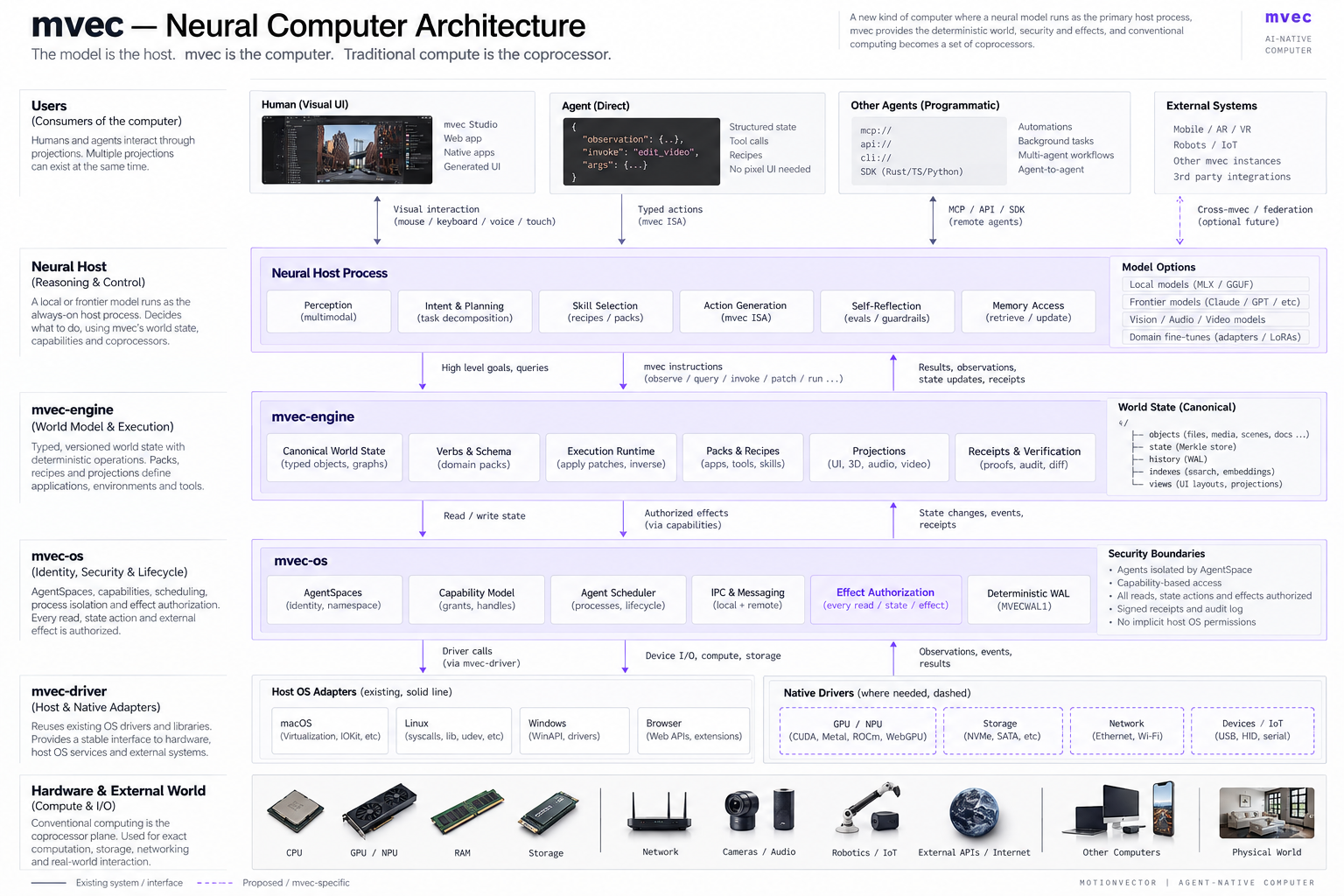
Intelligence, world, authority, execution.
Large models are extraordinary decision machines. They are also stochastic, steerable and fallible. Putting one at the center of a computer does not mean giving it unrestricted authority over that computer.
A neural host should speak a tiny typed instruction set.
Today’s agents often receive enormous tool surfaces: API catalogs, CLI documentation, DOM trees, screenshots, MCP schemas and application-specific conventions.
We are exploring the opposite direction: what is the smallest useful instruction set a neural host needs?
observe(handle)
query(selector)
invoke(object, verb, args)
patch(object, delta)
run(recipe)
call(coprocessor, args)
project(view_spec)
checkpoint()
ask_human(question)
The world is state, not pixels.
A model should not have to reconstruct its computer from screenshots every time it wants to act. In mvec, durable reality can be represented directly.
What happens to applications?
Consider email. Today, a person or agent typically enters an application boundary before reaching the underlying information. In a neural computer, email can instead become typed objects, legal verbs and a provider driver.
The provider still exists underneath. The difference is that it no longer has to be the environment in which the intelligence lives.
Software becomes a set of separable primitives.
recipe: publish-video

requires:
  read(project)
  invoke(video.render)
  invoke(storage.write)
  invoke(network.publish)

steps:
  validate_project
  render_master
  verify_output
  publish
  record_receipt
Linux becomes very good firmware.
We are not proposing that everyone throw away existing operating systems tomorrow. Existing computers contain decades of useful machinery: filesystems, TCP/IP, graphics drivers, USB, codecs, databases, browsers, compilers and device support.
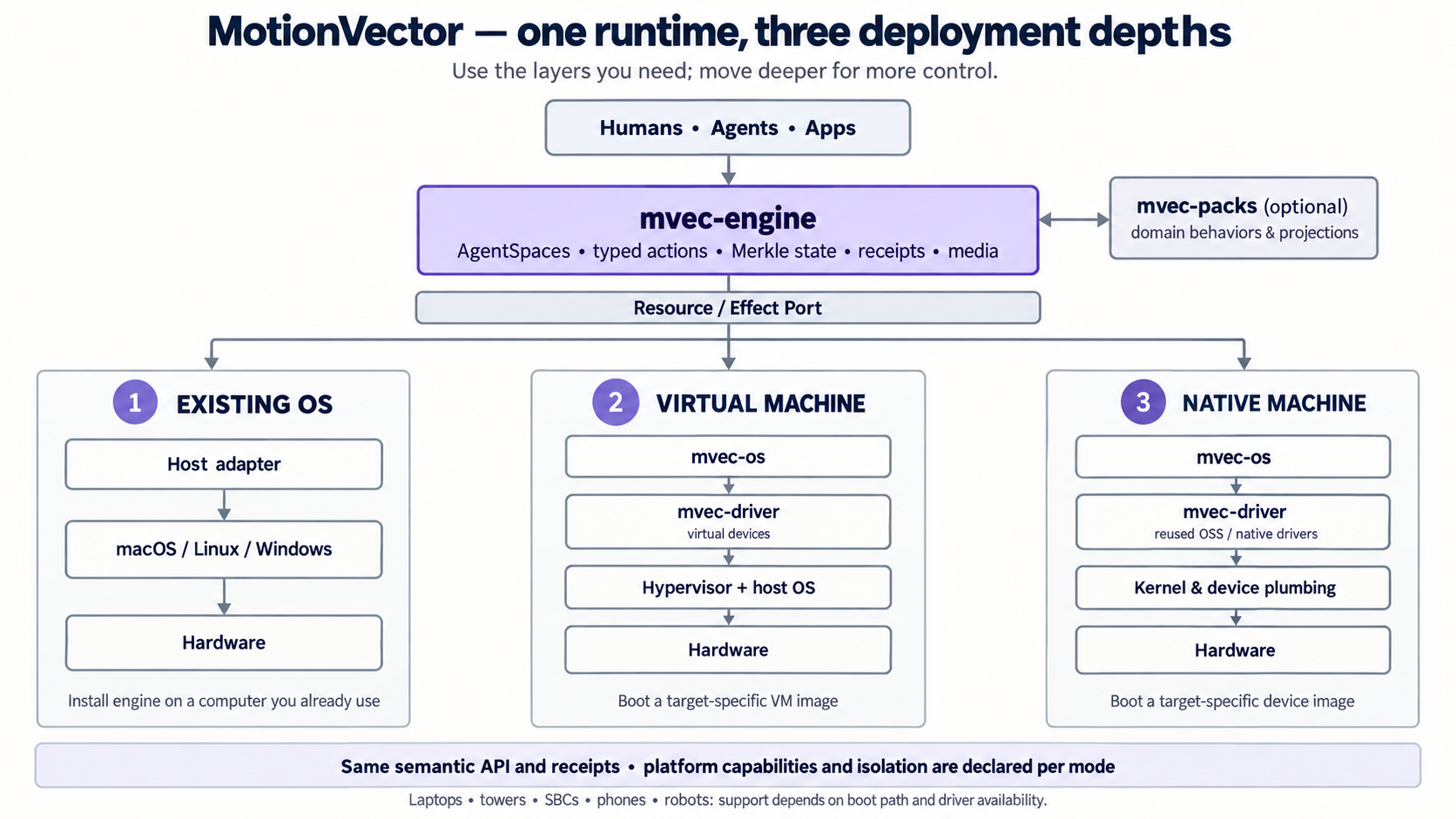
The near-term gate is deliberately smaller than “replace the OS.”
A model remains the host process.
mvec is its durable world.
The host speaks a tiny typed ISA.
Every effect passes through capabilities.
Deterministic operations return receipts.
Classical software appears as coprocessors.
Humans interact through projections of the same world.
Skills can be installed and revised by agents.
Frontier intelligence is an escalation and compiler path.
The machine can restart and recover its world without requiring conversation history.
A computer designed around intelligence at the top.
The previous era of software assumed humans were the operators. We built applications, windows, menus, files, buttons and programming languages around human limitations. Agents inherit that world today. They probably will not inherit it forever.
We’re going to build it and find out where the idea breaks.